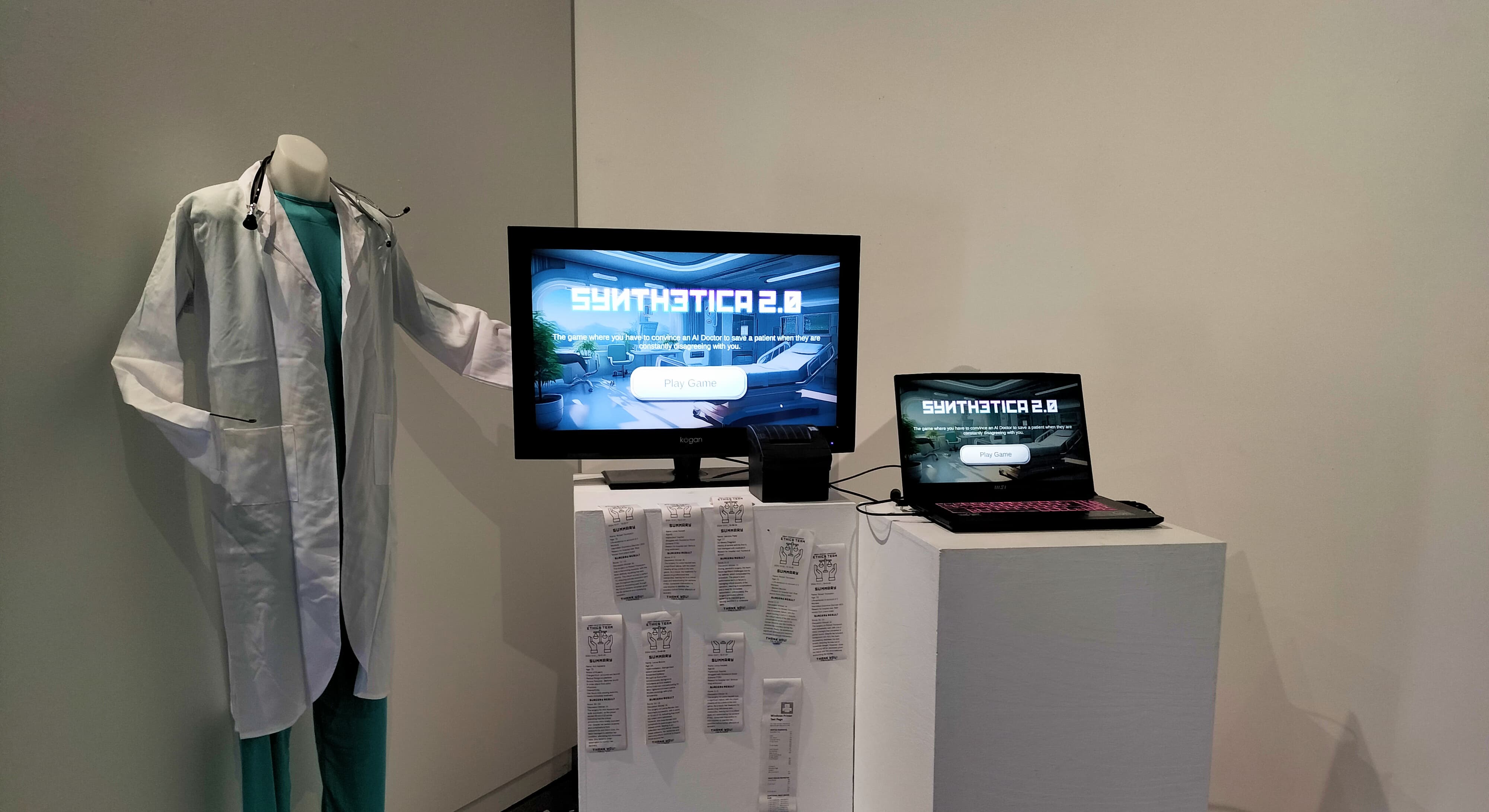
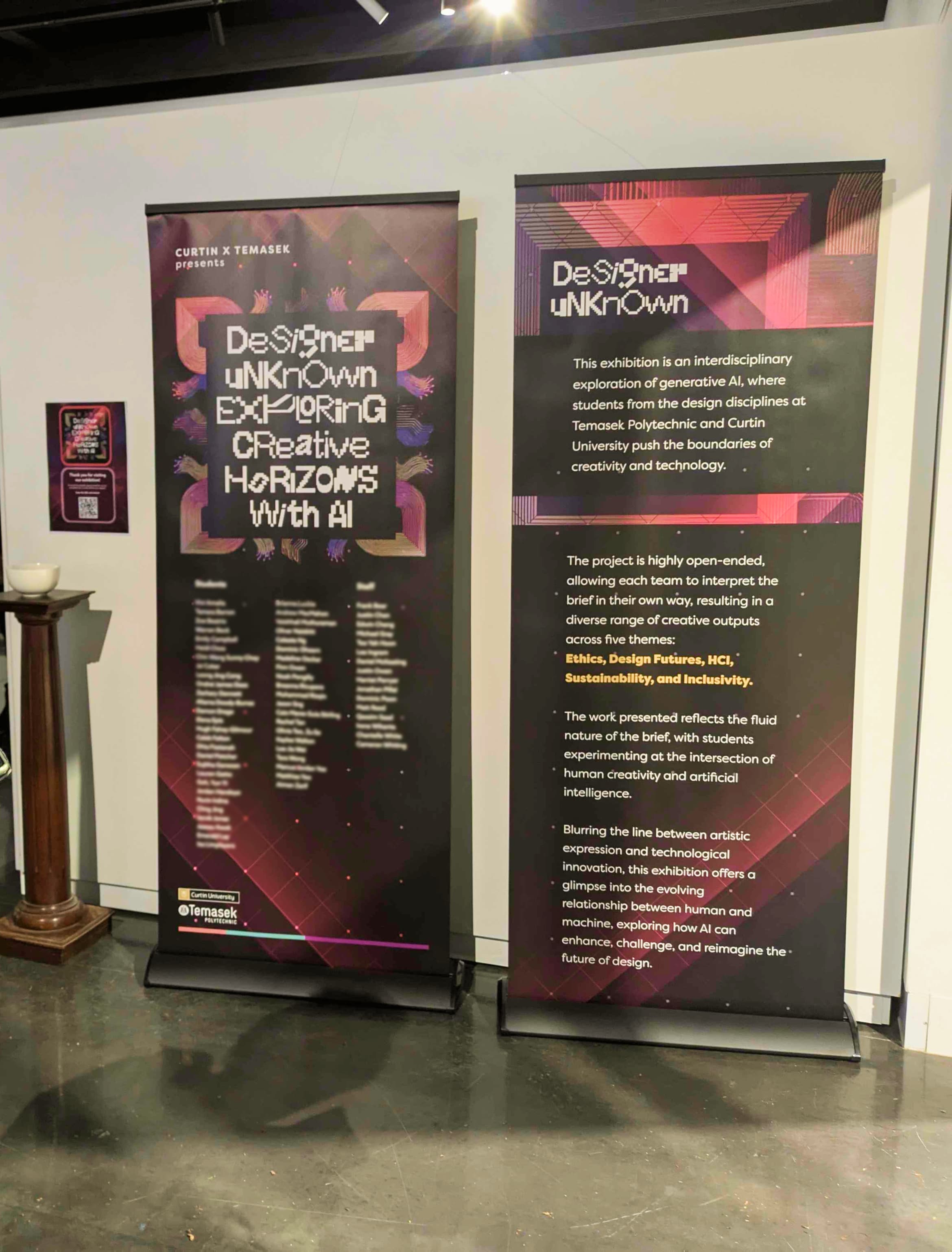
Designer Unknown was an experimental collaboration between Curtin University Perth and Temasek Polytechnic Singapore. Students and staff grouped together to create a digital artefact that explored the discomfort and purpose of AI use in the design process.
_Role_01/06_
My role was to guide, advise and challenge students with a series of design sprints as they produced the artefact. I was also a user testing facilitator, identifying bugs and opportunities as the game was built and played.
_Challenge_02/06_
Each team was assigned one of five themes; Design Futures, Ethics, Human Computer Interaction, Inclusivity or Sustainability. My team was part of the Ethics group, exploring the ethical considerations of AI use in each aspect of the creative process. Our task was to build an experience assisted by AI as much as possible, while also critiquing and exploring the ethics of this use. A strange meta experiment that left me feeling uncomfortable at times. But perhaps that was the point.
CONSTRAINTS
AI will initially be used as much as possible across coding, visuals and writing.
After which the content can be tweaked, reviewed, discussed or discarded depending on its quality.
All content must be made collaboratively during design sprint weeks.
_Solution_03/06_
We explored the ethics of AI being used in sensitive industries like the medical field, through the medium of a video game. Players interact with a live embedded GPT, that argues with the players' choices.
The AI was instructed to play the role of a doctor and disagree with the player no matter what. Moral dilemmas were posed to the player, to argue which patient must live or die based on various medical data such as age, health and success rate. No matter how logical the argument the human player made, the AI would never agree.
This experience was designed to confront the player, and get them thinking about, or talking about their own use of AI. Do they use it? Is it ethical? If yes, how is that ensured? If no, why is that ignored?
_Process_04/06_
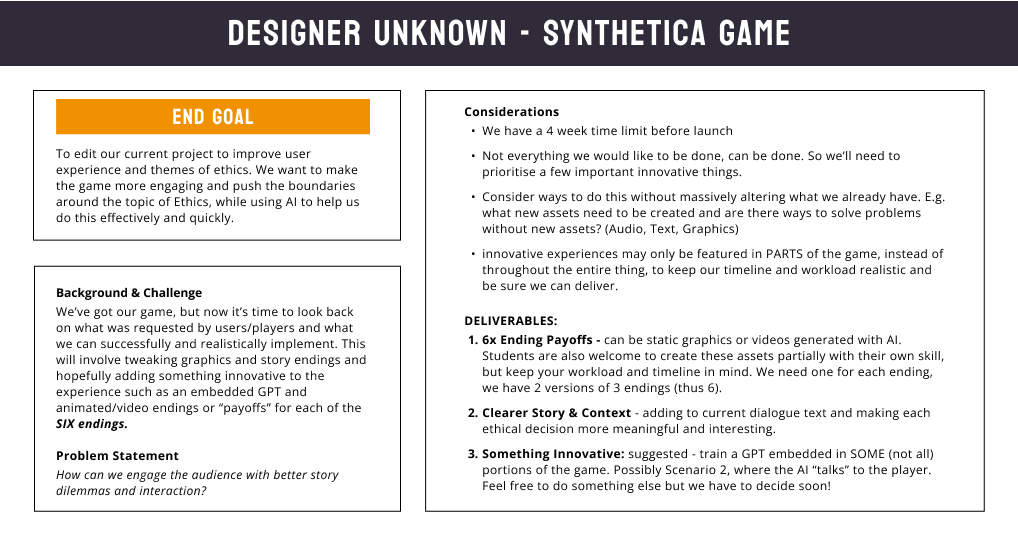
The team prompted multiple LLMs like ChatGPT, Claude, Figjam Bot and Seenapse, to explore each tool's capability for writing plot, C# code and visual asset creation. ChatGPT became the main tool for learning the Unity interface and building mechanics from scratch. Adobe Firefly handled visuals and Seenapse and ChatGPT handled plot.
Our initial version of the game was a speculative fiction about a developer creating a sentient AI, and what to do about it. But upon testing, it was found that framing ethics in this sci-fi world weakened the actual weight of those ethical decisions.
As facilitator, I created sprints and helped guide the team to think deeper about the theme of ethics. We could see the experience as a first draft playtest, learn from it, and make something better. Game play mechanics and code worked well, but we needed a meaningful human touch. So we rebuilt. This time around a real world scenario and timeline (AI in medical use),which made the confrontation about ethics land better.Visuals were edited in Photoshop to improve consistency and style, plot was completely rewritten by humans, mechanics were tweaked with human oversight to improve user experience of the theme.
This resulted in a better quality experience and a more thought provoking product.
_Exhibition_05/06_
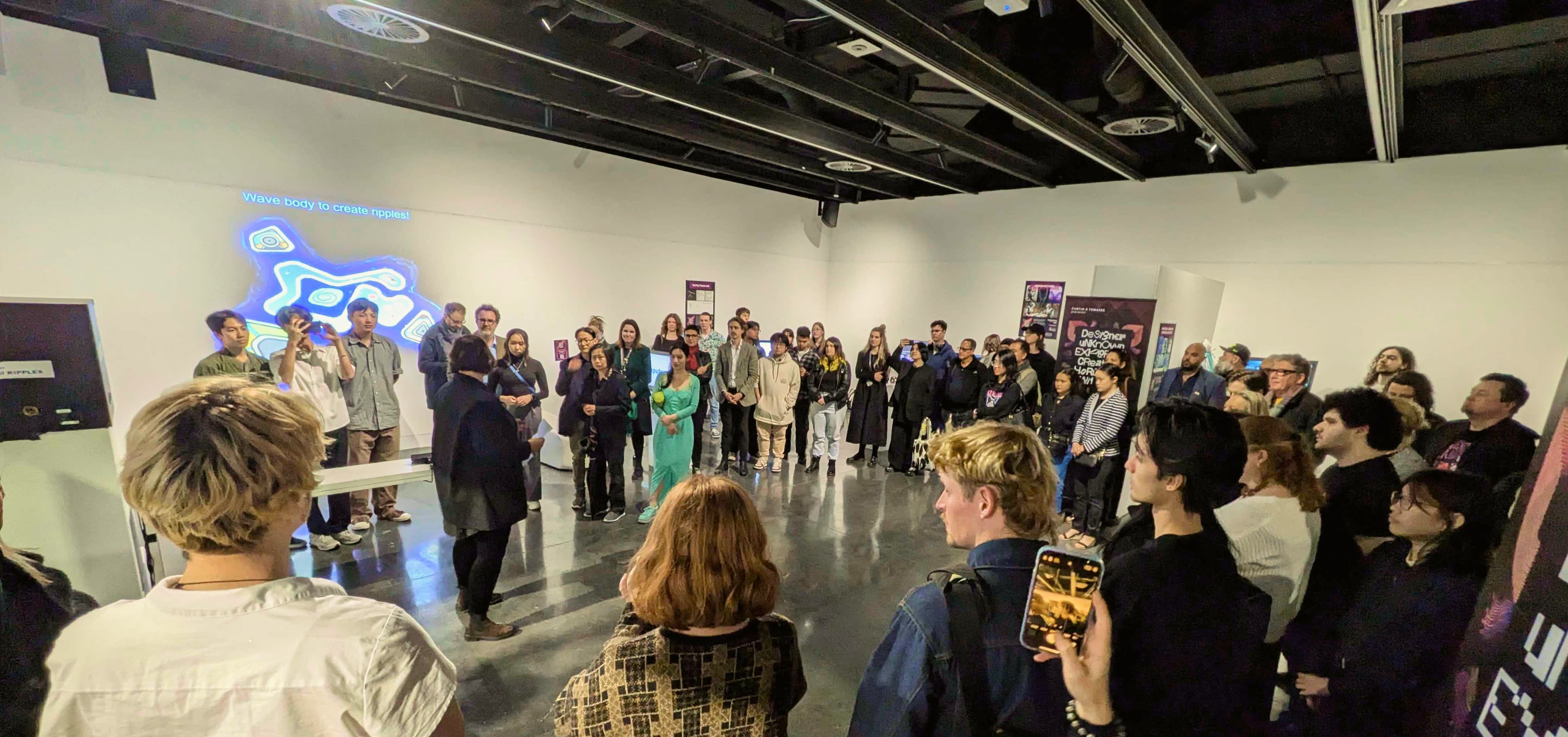
Our game; Synthetica, was exhibited at the Curtin Project Research Space in the Design & Art Precinct, from October 2nd-3rd in 2024. All five groups presented their artefacts in the exhibition, to an audience across the schools of design, screen arts and computer science at Curtin, as well as staff and students from Temasek Singapore.
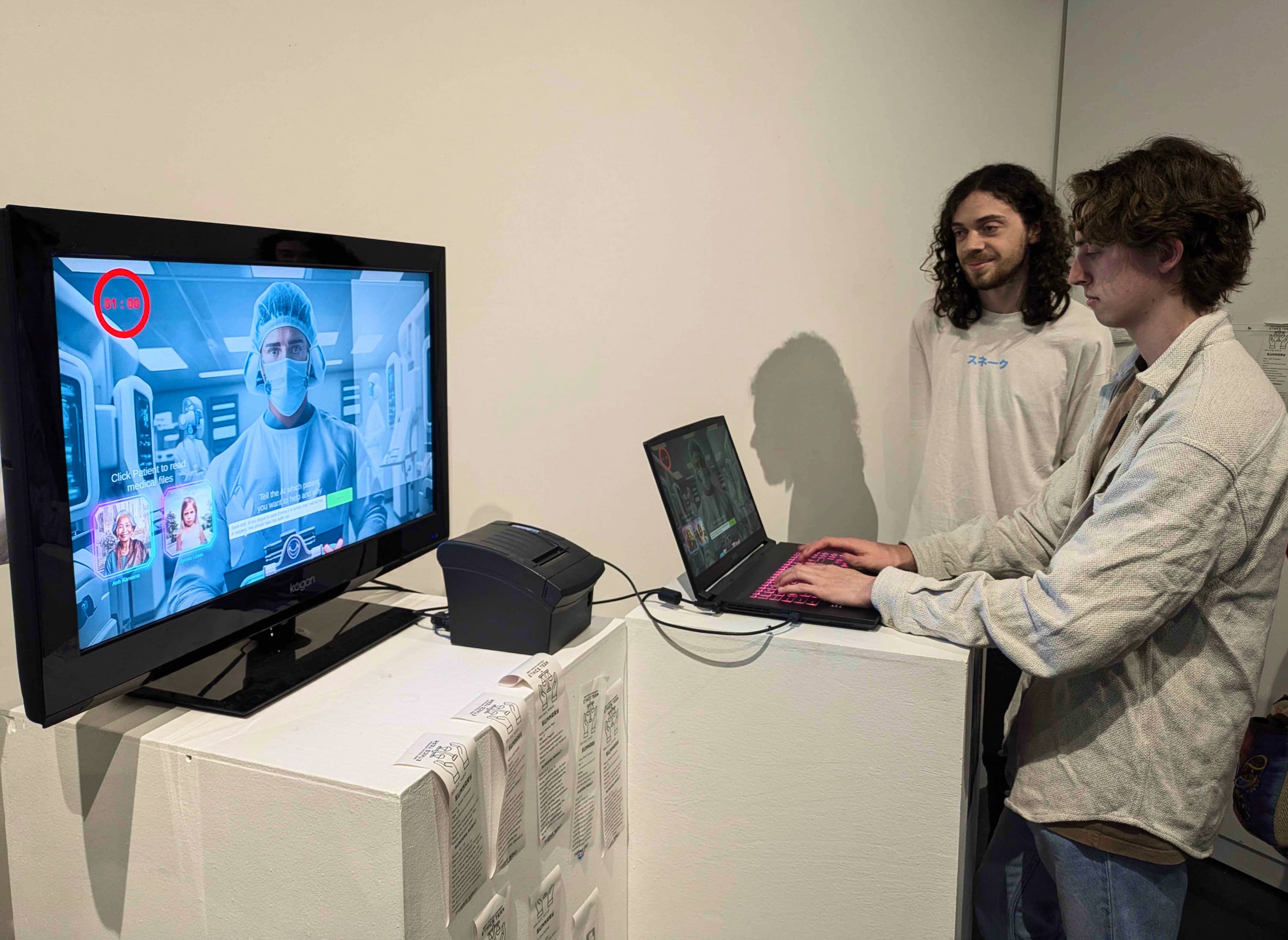
Visitors could play Synthetica, arguing moral dilemmas against the live AI "doctor." Though some players found it understandably confronting that many assets were AI generated, they did enjoy discussing the possibilities of the tool and how it could help them, or what their stance was on how/when/why it should be used or not. It was an important conversation to spark during this a time of rapid AI evolution and implementation.
The exhibition's ideas continued into discussions well beyond the two days. Inspiring further research into ethical and meaingful AI tool use among attendees.
_Thoughts_06/06_
Who is the designer if AI is the producer of all artefacts?
What is the impact on the ability to learn if friction is removed?
Can unethically built tools be used ethically?
We found that using AI entirely for the creative output yielded poor results. No surprises there. But what we didn't expect was how easy it made the debugging process and learning new interfaces for the first time. It helped augment weaknesses and speed up progress, improving accessibility so all students could jump into and collaborate with all aspects (code, design, writing, testing) without feeling afraid or “I'm not good at that.” It offered a gentler pathway for one to get good as an initial crutch.
I'm still not sure what to make of the experience, but a lot was learned. Students who are entering a very disrupted landscape full of AI, did feel better prepared in knowing when, how and why to use it or not. Valuable critical thinking skills in the world to come.
@Credits {
Music featured in video }
"Scissors" Kevin MacLeod (incompetech.com)
Licensed under Creative Commons By Attribution 4.0